
Need help moving your thesis forward? If you’re stuck or overwhelmed, our PhD writing and editing support can help you get things moving again. Click here to see all of our PhD services.
Writing a thesis is an intense journey, and it is normal to encounter writer’s block along the way. Graduate students often find themselves struggling to start a new section or getting stuck in the middle of a chapter. However, it is crucial to remember that these hurdles are common, and you can overcome them with the right strategies.
Acknowledging that writing often progresses in fits and starts (McDowall, 2020) can help you prepare yourself mentally for setbacks. It also allows you to focus on regaining momentum whenever you feel stalled.
Set small goals to build momentum
A frequent cause of writer’s block is feeling overwhelmed by the sheer scale of a thesis. Instead of aiming to perfect an entire chapter in one go, break the work into bite-sized tasks. For instance, set a simple goal to write 200 words or draft a single figure caption at a time. Achieving these modest targets provides a sense of accomplishment and builds momentum, making it easier to continue (McDowall, 2020). Over time, these small wins accumulate into significant progress.
Another strategy is to divide the thesis into manageable sections with interim deadlines – this can reduce anxiety by clarifying what to tackle next. By focusing on one piece at a time, you can chip away at the project steadily, which helps maintain continuity and motivation.
You might also consider using structured writing techniques such as the Pomodoro method to stay on track. Writing in short, focused bursts (for example, 25 minutes of writing followed by a 5-minute break) can make the task feel less daunting. This approach encourages intense focus for a short period and then rewards you with a break, so you return refreshed.
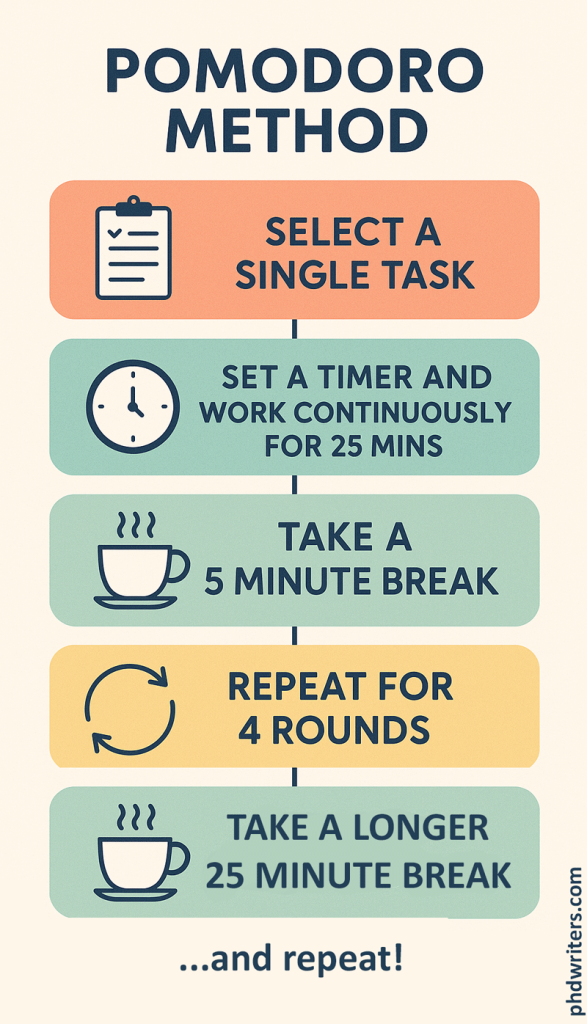
Use this timer to help you! 👉 Pomofocus timer
Even a brief scheduled session – even ten minutes of writing – can help break through an initial block. Such small efforts build writing momentum (Purdue University, n.d.). Consistent, incremental gains over days and weeks will bring you much closer to a completed thesis draft without the process feeling insurmountable.
Change your writing approach and environment
When you find yourself intimidated by a blank page or stuck on phrasing an idea, it can help to switch how or where you are writing. One effective strategy is free-writing: give yourself permission to write a rough, unfiltered draft of your thoughts without worrying about polish or accuracy. This technique can bypass your inner critic and get words onto the page. Later, you can revise and refine the text, but initially the goal is simply to overcome inertia.
Don’t stop for anything. Go quickly without rushing. Never stop to look back, to cross something out, to wonder how to spell something, to wonder what word or thought to use, or to think about what you are doing…Editing, in itself, is not the problem. Editing is usually necessary if we want to end up with something satisfactory. The problem is that editing goes on at the same time as producing…
Similarly, if you cannot articulate a concept in writing, try explaining it out loud to a colleague or friend. Talking through a stubborn section in plain language can offer a fresh perspective and often reveals the simple essence of what you want to say (Agnes Scott College, n.d.). Indeed, discussing your ideas with someone else – or even with an empty room – can expose gaps in your logic and spark new ways to express an argument.
Do not underestimate the influence of your environment on productivity. A change of scenery – such as moving from your usual desk to a library carrel or a café – can sometimes help shake off a mental block. Some students find that writing in a different location or at a different time of day breaks the monotony and stimulates creativity.
If background noise or silence affects you, adjust your surroundings accordingly. For example, you might use noise-cancelling headphones or play soft music, or conversely seek a bustling setting if that energises you. The key is to find a space where you feel focused yet comfortable. By altering your routine or environment when you are stuck, you send a signal to your brain that it is time to work – but in a fresh way – which can be enough to get words flowing again.
Establish a routine and seek support
Writer’s block is less likely to take hold if writing becomes a regular habit rather than a rare, high-pressure event. Therefore, consider scheduling dedicated writing time in your calendar just as you would book a meeting or a class. By setting aside consistent time slots for writing – for example, an hour every morning or a few afternoons each week – you train yourself to write on cue. This routine builds writing stamina and makes the task feel like a normal part of your day.
Notably, researchers have found that writers who write on a daily or very frequent basis experience shorter periods of writer’s block than those who write sporadically (Rose, 1984). Consistency, even in small amounts, keeps your thesis at the forefront of your mind and maintains momentum.
Alongside establishing a personal routine, it can be highly beneficial to write in the company of others. Many universities run writing bootcamps or thesis writing retreats for postgraduates, which provide a structured, supportive environment to concentrate on writing.
For example, the Thesis Boot Camp programme at RMIT University in Australia is an intensive writing retreat that helps students overcome writer’s block and thesis fatigue while making substantial progress on their thesis in a short time (RMIT University, 2023). These group sessions often involve writing in timed blocks with regular breaks (similar to the Pomodoro technique), but with the added benefit of peer support.
Likewise, informal writing groups or “Shut Up and Write” meetups at Manchester University (UK) allow researchers to write side by side in a quiet setting. The social aspect provides gentle accountability. Knowing that your peers are also working can push you to stay on task. It also helps alleviate the isolation that can magnify procrastination. In a brief two-hour communal writing session, it is amazing what you can get done simply by focusing together without distractions (University of Manchester Library, 2023). By joining forces with a writing community, you gain encouragement, accountability, and shared tips for productivity. All of these can propel you through periods of low motivation.
Overcome perfectionism and keep perspective
An often unspoken battle during thesis writing is the internal emotional struggle. Anxiety, self-doubt, and the pursuit of perfection can all exacerbate writer’s block. As submission nears, many students fear their work is not good enough and worry about how others will judge it. It is important to remind yourself that no thesis is perfect, and it does not need to be (McDowall, 2020). In fact, experienced academics emphasise that “a good PhD is a finished PhD” (McDowall, 2020). In other words, completion is an achievement in itself. Therefore, try to let go of unrealistic perfectionism and focus on making your thesis good enough to submit. Embracing this mindset can relieve the pressure that often paralyses writing.
Remember that you will have opportunities to improve and polish your work through revisions and feedback from your supervisor. Even the viva voce examination provides a chance to refine your final thesis. Each draft is just a draft, not the final verdict on your intellect.
When self-doubt creeps in or you feel stuck on a particularly troublesome section, take a step back. Consider returning to your outline or notes to reconnect with your overall argument. Alternatively, talk through the problematic section with your supervisor or a mentor, who can often provide fresh insight and reassurance. Sometimes an outside perspective will illuminate a simple solution you may have overlooked. It can also validate that you are on the right track after all.
Additionally, recognise when you need to step away and recharge. Working continuously on the thesis can drain your creativity and motivation. Taking a short break – whether an afternoon off, a brisk walk, or even a full day away from academic work – can restore your energy. It may also give you fresh insight. A brief change in activity allows your subconscious to untangle ideas, so you often return to your writing with renewed clarity. Walking comes highly recommended!

Walking has long been championed by writers, poets, and philosophers as a catalyst for creativity. Virginia Woolf walked the streets of London to generate ideas, and William Wordsworth was said to have walked nearly 180,000 miles in his lifetime, composing poetry as he roamed. Writing and walking are linked by the kinds of thinking provoked in the writer.
“Only thoughts reached by walking have value.”
Indeed, research suggests that downtime and rest play a role in creative problem-solving. Therefore, a well-timed break can actually accelerate your progress once you resume writing. The key is to break the cycle of stress and stagnation. By caring for your mental well-being and keeping the thesis in perspective, you will find it easier to maintain momentum in the long run.
Wrapping up:
Overcoming writer’s block in thesis writing involves both smart writing practices and a healthy mindset. Setting manageable goals, experimenting with different writing techniques, developing a steady routine, and seeking support from peers and mentors will keep your thesis moving forward even when motivation falters.
Accepting that imperfection is part of the process and taking care of your well-being will help protect your creative drive. Every student’s journey is unique, but these strategies can help break through the blocks that impede progress.
Writing a thesis is a marathon, not a sprint – and occasional hurdles are inevitable. However, with perseverance and the right approach, you can maintain momentum, overcome those blocks, and ultimately cross the finish line.
References and recommended reading:
- Agnes Scott College (n.d.) Getting Past Writer’s Block. Center for Writing and Speaking, Agnes Scott College. [Online]. Available at: https://www.agnesscott.edu/center-for-writing-and-speaking/handouts/getting-past-writers-block.html (Accessed 10 December 2025).
- McDowall, A. (2020) “A good PhD is a finished PhD”: tips for completing your thesis from academics who’ve been there. Birkbeck Perspectives. [Online]. Available at: https://perspectives.blogs.bbk.ac.uk/2020/06/22/tips-for-completing-your-phd-from-academics-whove-been-there/ (Accessed 10 December 2025).
- Purdue University (n.d.) Symptoms and Cures for Writer’s Block. Purdue Online Writing Lab. [Online]. Available at: https://owl.purdue.edu/owl/general_writing/the_writing_process/writers_block/index.html (Accessed 10 December 2025).
- RMIT University (2023) Thesis Boot Camp. RMIT Research Plus Programme. [Online]. Available at: https://www.rmit.edu.au/students/my-course/research-students/research-plus/thesis-bootcamp (Accessed 10 December 2025).
- Rose, M. (1984) Writer’s Block: The Cognitive Dimension. Carbondale: Southern Illinois University Press.
- University of Manchester Library (2023) Shut Up and Write (on campus) [Event description]. My Research Essentials, The University of Manchester Library. [Online]. Available at: https://www.library.manchester.ac.uk/training/my-research-essentials/workshops/details/?event=s732wItH (Accessed 10 December 2025).